At a Glance
- Papers must be submitted in printable PDF format.
- No page limit for references. Other than references, all materials, including appendix, must fit within the page limit.
- References must include all authors (i.e., do not use et al.).
Guidelines for Use of Generative AI Tools
We refer authors to the ACM and IEEE policies on authorship, respectively.
- Authors are allowed to use generative AI tools to prepare their papers with explicit disclosure on how the generative AI tools are used in the Acknowledgement section.
- Generative AI tools cannot be listed as an author.
- All the co-authors take full responsibility for the contents of their paper.
The use of AI systems for editing and grammar enhancement is common practice and, as such, is generally outside the intent of the above policy. In this case, disclosure as noted above is not required, but recommended.
This document serves as a set of guidelines for submissions to the 53rd IEEE/ACM International Symposium on Computer Architecture (ISCA 2026). The format is derived from the IEEE's LaTeX template file, and is used with an objective of keeping the submission version similar to the camera-ready version. In an effort to respect the efforts of reviewers and in the interest of fairness to all prospective authors, we request that all submissions to ISCA 2026 follow the formatting and submission rules detailed below. Submissions that violate these instructions may not be reviewed, at the discretion of the program chairs, in order to maintain a review process that is fair to all potential authors.
As with prior ISCAs, there will be a main track and an industry track. For additional guidelines on industry submissions, pleas see the industry track submission guidelines.
Paper Evaluation Objectives
The committee will make every effort to judge each submitted paper on its own merits. There will be no target acceptance rate. We expect to accept a wide range of papers with appropriate expectations for evaluation — while papers that build on significant past work with strong evaluations are valuable, papers that open new areas with less rigorous evaluation are equally welcome and especially encouraged. We also acknowledge the wide range of evaluation methodologies in ISCA including modeling, simulation, prototyping, experimental implementation, real product evaluation, etc.
Content
Double Blinding
Reviewing will be double blind. Please:
- Do not include any author names on any submitted documents except in the space provided on the submission form.
- Ensure that the metadata included in the PDF does not give away the authors.
- Fully anonymize any links to artifacts (e.g., GitHub repository). Remove any links to artifacts that cannot be fully anonymized.
-
If you are improving upon your prior work, refer to your prior work
in the third person and include a full citation for the work in the
bibliography.
- For example, if you are building on your own prior work in the papers, you would say something like: “While the authors of [x][y] did X, Y, and Z, this paper additionally does W, and is therefore much better.”
- Do NOT omit or anonymize references for blind review.
- If you have already put your manuscript on the Web in some way, such as arXiv, use a different title for the version you submit to ISCA.
Figures and Tables
- Ensure that the figures and tables are legible.
- Ensure that you refer to your figures in the main text.
- If you use colors for your figures, ensure that the different colors are highly distinguishable in grayscale. Many reviewers print the papers in gray-scale.
References
Each reference must explicitly list all authors of the paper; there are no page limits. Authors of NSF proposals should be familiar with this requirement. Knowing all authors of related work will help find the best reviewers. Since there is no length limit for the number of pages used for references, there is no need to save space here.
Papers not meeting this requirement will be rejected.
Text/Figure Reuse
In addition, it is important to note that ACM/IEEE prohibit authors from reusing their own text or figures without attribution; doing otherwise either violates rules regarding plagiarism or anonymity. This applies to published works only, i.e. not IEEE CAL or arXiv works.
As always, if you are in doubt, it is best to contact the program chairs.
Paper Formatting
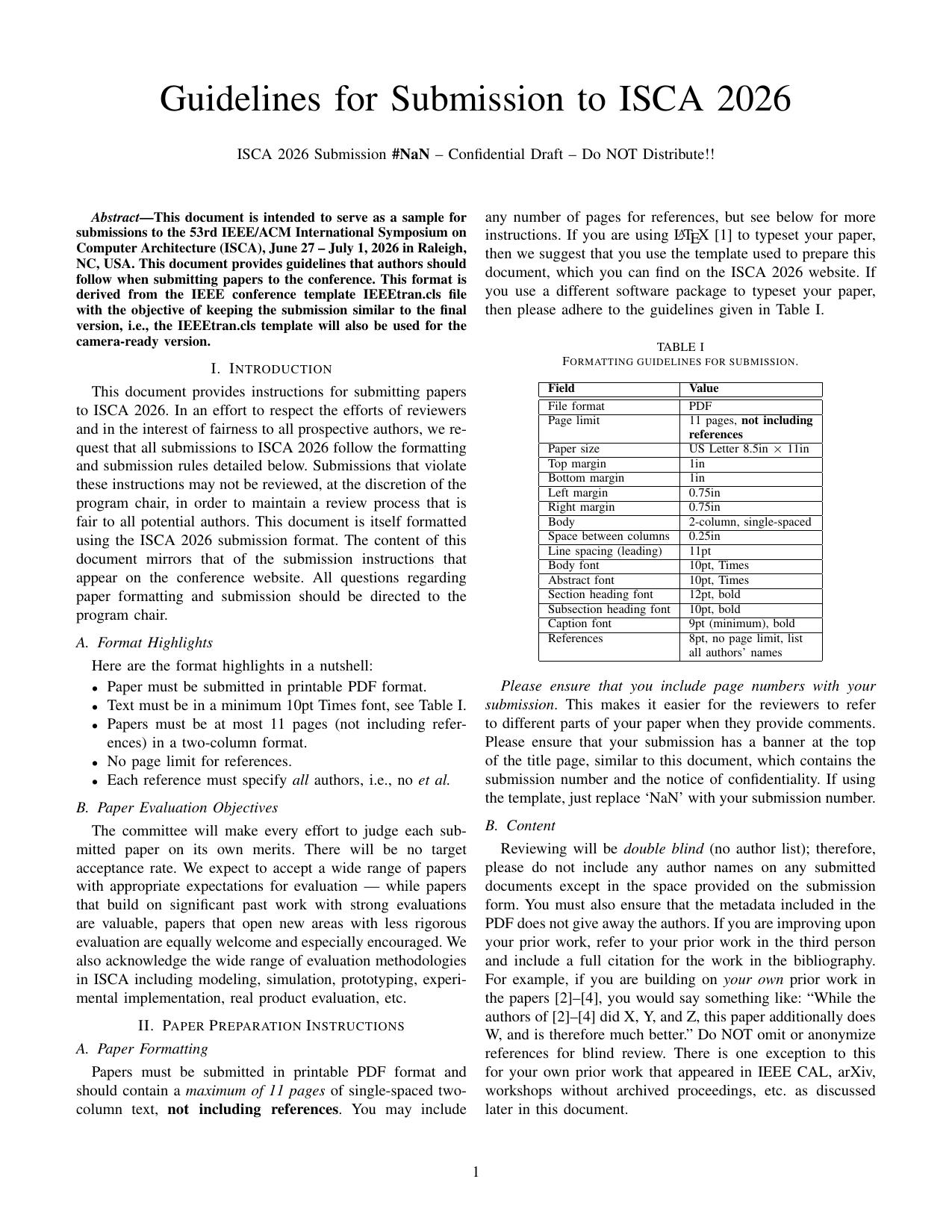
Papers must be submitted in printable PDF format and should contain a maximum of 11 pages of single-spaced two-column text, not including references. You may include any number of pages for references, but see below for more instructions. If you are using LaTeX to typeset your paper, then we suggest that you use the ISCA 2026 IEEE template. The sample paper was prepared with that template. The general IEEE templates (Latex, Microsoft Word or Overleaf) can be accessed via the IEEE manuscript page.
Please ensure that you include page numbers with your submission. This makes it easier for the reviewers to refer to different parts of your paper when they provide comments. Please ensure that your submission has a banner at the top of the title page, which contains the submission number and the notice of confidentiality.
Note: Table values updated on Nov. 11, 2025 to reflect the values found in the IEEE Conference Proceedings Template . The template IEEEtran.cls adheres to the current IEEE Conference Template, and was not changed from earlier versions of the ISCA 2026 template.
| Field | Value |
|---|---|
| File Format | |
| Page Limit | 11 pages, not including references |
| Paper Size | US Letter: 8.5in x 11in |
| Top Margin | 0.75in |
| Bottom Margin | 1in |
| Left Margin | 0.625in |
| Right Margin | 0.625in |
| Body | 2-column, single-spaced |
| Space Between Columns | 0.25in |
| Line Spacing (Leading) | 12pt |
| Body Font | 10pt, Times |
| Abstract Font | 9pt, Times, bold |
| Section Heading Font | 10pt |
| Subsection Heading Font | 10pt |
| Caption Font | 8pt |
| References | 8pt, no page limit |
Additional Rules for Authors
Authors MUST:
- Abide by the ACM code of ethics and the IEEE code of ethics.
- Abide by the criterion for authorship laid out by ACM and IEEE. Authorship is reserved only for individuals making substantial intellectual contributions. Gifting authorship is strictly prohibited.
- List all legitimate CoIs and only legitimate CoIs. Asking someone for feedback on a draft of the paper or discussing the idea with someone does not create a CoI.
- Abide by the concurrent submission policy.
- Report any allegations of submission or reviewing misconduct to the Program Chairs, who has the responsibility to follow up on them. The only exception is if the complaint is about the Program Chairs; in this case, the Steering Committee should be contacted.
- Make no assumptions as to whether a particular paper represents a “community paper” and whether its co-authors are or are not conflicted with each other. The decision rests entirely with the Program Chairs, who must be either petitioned explicitly or will be presented with the choice through a conflict-tracking tool. A community paper is defined as a paper presenting a survey, compendium, tool, or artifact to which multiple authors contribute without engaging in an actual project collaboration (e.g., a paper describing an open-source software framework to which the authors have contributed different modules).
Authors MUST NOT:
- Contact reviewers or PC members about any submission, including their own. This includes asking about the outcome of a submission following the online discussion period and the PC meeting. Similarly, authors are not allowed to ask another party to contact the reviewers on their behalf.
- List potential reviewers as conflicts of interest based solely on fear or suspicion of a negative bias. If an author believes there exists clear and articulable evidence of a negative bias against their work from a potential reviewer, the author may contact the Program Chairs and present such evidence in support of their case. The Program Chairs must acknowledge receipt and may solicit additional information. The Program Chairs are not required to notify the authors of any decision taken.
- Attempt to sway a reviewer to review any paper positively or negatively.
- Contact reviewers or PC members requesting any type of information about the reviewing process, either in general or specifically about submitted papers.
- Disclose the content of reviews for one’s paper publicly before the results are announced. Any grievances should be directed to the Program Chairs.
Acknowledgments
This document is derived from previous conferences, in particular ISCA 2024.